

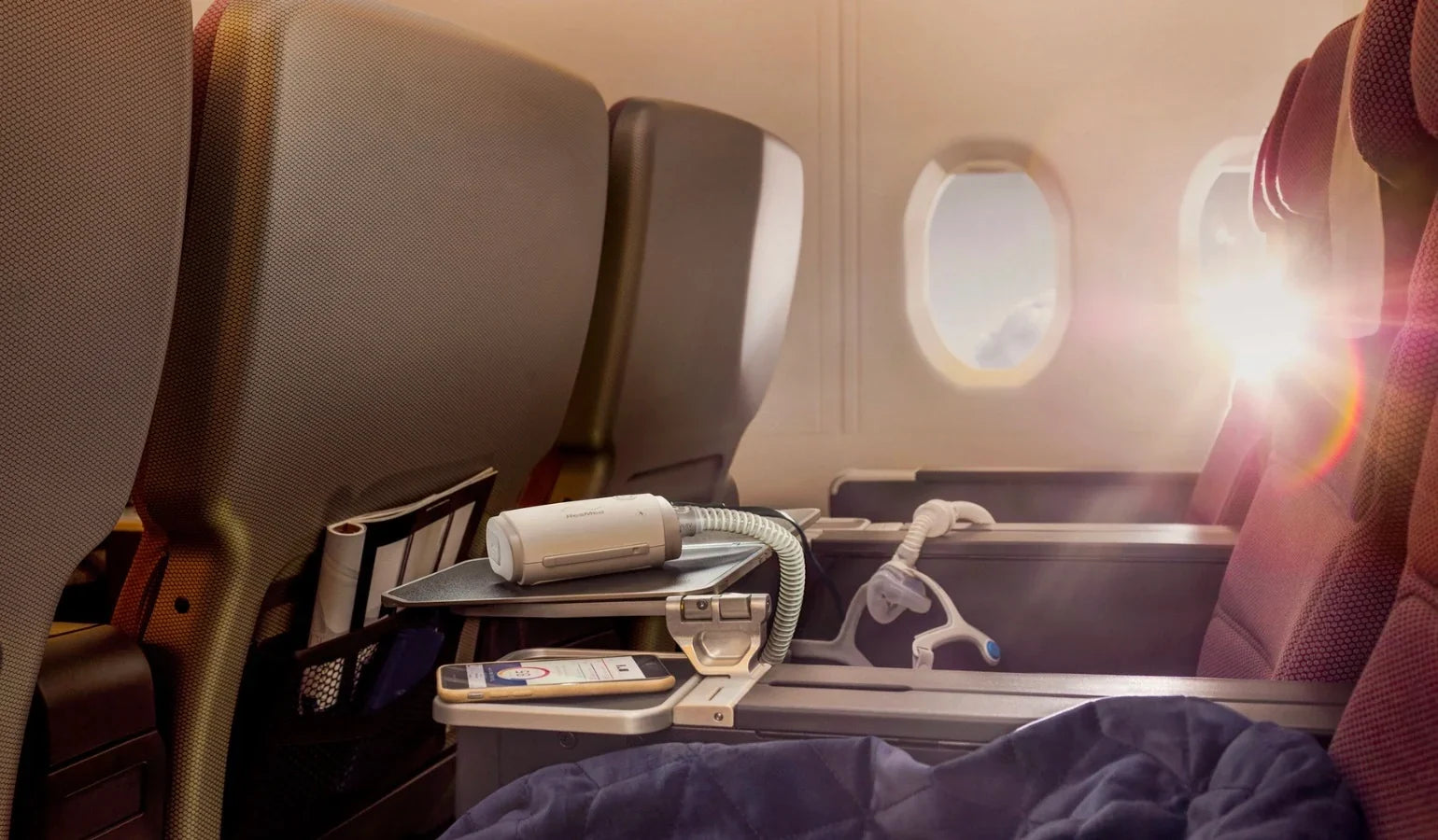
Summer vacation is almost here, and if you use a CPAP machine, you already know the drill: the trip planning starts early and the packing list is a little longer than everyone else's. The good news is that travel CPAP machines have come a long way. The best options available in Canada right now are genuinely compact, quiet, and easy to use on the road, whether you are flying to Europe, driving to a cottage, or camping in the backcountry. Here is what you need to know before you pack.
Do You Need a Separate Travel CPAP Machine?
Not necessarily. Many full-size home CPAP machines, including the ResMed AirSense 10 and AirSense 11, are already approved for use on commercial aircraft and are compatible with international voltage standards. If your home machine is relatively recent, you may be able to bring it along without buying anything new.
That said, a dedicated travel CPAP machine makes sense for a few specific situations. If your home machine is bulky and you are trying to travel with carry-on only, a compact travel device saves significant space. If you are camping or spending time off-grid, some travel machines are designed to run on battery power or DC car adapters. And if you simply want to keep a second machine ready to grab without repacking your bedside setup each time you travel, a dedicated travel unit is a practical investment.
Best Travel CPAP Machines Available in Canada
ResMed AirMini
The ResMed AirMini is the most popular travel CPAP machine in Canada and for good reason. It weighs just 300 grams and fits in the palm of your hand, making it the most compact full-featured APAP machine on the market. Despite its size, it delivers the same AutoSet therapy algorithm as the full-size AirSense machines, so your therapy quality does not change when you travel.
The AirMini connects to your smartphone via Bluetooth and the myAir app, giving you the same nightly therapy data you get at home. It is compatible with a range of ResMed masks through dedicated HumidX waterless humidification inserts, which add moisture to the airflow without requiring a water chamber. This makes it ideal for flights and hotels where filling a humidifier chamber is inconvenient.
The AirMini is FAA-approved for use on commercial flights and works on international voltage (100 to 240V). A battery pack is available separately for off-grid use.
Best for: Frequent flyers, carry-on-only travellers, and anyone who wants a seamless extension of their home ResMed therapy setup.
Philips Respironics DreamStation Go
The Philips Respironics DreamStation Go is the main alternative to the AirMini in the Canadian market. It is slightly larger than the AirMini but includes an integrated humidifier chamber, which is a meaningful comfort advantage if you rely on humidification and prefer not to use waterless inserts.
The DreamStation Go uses the same AutoTravel mode as Philips' home machines, which automatically adjusts to altitude changes during flight. It connects to the DreamMapper app for therapy tracking and is compatible with a wide range of standard CPAP masks, giving it more mask flexibility than the AirMini.
A heated tube adapter is available for the DreamStation Go, and a dedicated travel battery is sold separately. Like the AirMini, it is FAA-approved and compatible with international voltage standards.
Best for: Travellers who rely on active humidification, existing Philips users, and anyone who wants wider mask compatibility in a travel device.
Browse all travel CPAP machines at PAPSmart
Travel CPAP Comparison: AirMini vs DreamStation Go
| Feature | ResMed AirMini | Philips DreamStation Go |
| Weight | 300g | Approx. 660g |
| Humidification | Waterless HumidX inserts | Integrated water chamber |
| App | myAir | DreamMapper |
| Mask compatibility | ResMed masks with AirMini connector | Standard CPAP masks |
| Battery option | Available separately | Available separately |
| FAA approved | Yes | Yes |
| International voltage | Yes (100 to 240V) | Yes (100 to 240V) |
Flying With a CPAP Machine: What You Need to Know
CPAP machines are classified as medical devices by the Canadian Air Transport Security Authority (CATSA) and the TSA in the United States. This means you can bring your machine as a carry-on item in addition to your standard carry-on and personal item allowances on most airlines. You do not need to check it.
A few practical tips for flying with your CPAP this summer:
- Carry your prescription or a letter from your sleep physician when travelling internationally. Some customs agents ask for documentation when a medical device is declared.
- Remove your CPAP machine from its bag at airport security and place it in a separate bin for X-ray screening, the same way you handle a laptop.
- Water in your humidifier chamber must be emptied before going through security. Fill it again at your destination.
- If you plan to use your machine on the flight, confirm with your airline in advance. Most major carriers allow in-flight CPAP use with advance notice.
- Pack your power adapter and any destination-specific plug converters in your carry-on, not your checked luggage.
Using Your CPAP at a Cottage or Campsite
Summer in Canada means cottage season, and for CPAP users, that often means figuring out how to run therapy without a standard wall outlet. The good news is that battery solutions have improved significantly in recent years.
The ResMed AirMini and DreamStation Go both have compatible battery packs designed specifically for their machines. These typically provide one to two nights of therapy per charge without humidification, or one night with humidification enabled. For longer off-grid stays, a higher-capacity power station like a Jackery or Goal Zero unit will run most CPAP machines for several nights.
A few things to keep in mind for cottage and camping use:
- Disable the humidifier when running on battery power to significantly extend battery life. Most users find therapy is still comfortable without humidification for a night or two.
- Bring a DC car adapter if you have one. Running your CPAP from a vehicle's 12V outlet is a practical backup when a power station is not available.
- Store your machine in its travel case when not in use to protect it from dust, moisture, and insects.
- Distilled water is ideal for humidifier chambers. At a cottage, bottled water is a reasonable substitute if distilled is not available.
What to Pack: Your Summer CPAP Travel Checklist
Before you leave, run through this list to make sure nothing gets forgotten:
- CPAP machine and power cord
- International plug adapter (if travelling outside Canada or the US)
- CPAP mask, cushion, and headgear
- Spare cushion (cushions can tear in a packed bag)
- Humidifier chamber and distilled water, or HumidX inserts for the AirMini
- CPAP tubing
- Travel case or protective bag
- Battery pack or power station if travelling off-grid
- Prescription or physician letter for international travel
- Mask wipes for cleaning on the road
Replacing Supplies Before You Travel
If your mask cushion, filters, or tubing are overdue for replacement, summer is a smart time to refresh everything before you leave. Worn cushions leak more easily, and a leak that is manageable at home becomes a real problem in a hotel room or shared cottage space. Replacing your consumables now means you start your trip with equipment that is performing at its best.
Shop CPAP Supplies and Accessories at PAPSmart
Frequently Asked Questions
Can I bring my CPAP machine on a plane in Canada?
Yes. CPAP machines are classified as medical devices and are permitted as an additional carry-on item on most airlines. Remove the machine from its bag at security for separate X-ray screening and empty any water from the humidifier chamber before your flight.
Do I need a travel CPAP machine or can I bring my home machine?
Most modern home CPAP machines, including the ResMed AirSense 10 and AirSense 11, are already travel-compatible with international voltage support and FAA approval. A dedicated travel machine makes sense if you want a smaller, lighter device or need battery-powered operation for off-grid use.
How do I power my CPAP at a campsite or cottage without electricity?
A dedicated CPAP battery pack compatible with your machine provides one to two nights of therapy per charge. For longer stays, a portable power station will run most CPAP machines for several nights. Disabling the humidifier significantly extends battery life.
Is the ResMed AirMini worth it for occasional travel?
If you travel more than a few times per year or regularly travel carry-on only, yes. The AirMini delivers the same AutoSet therapy as full-size ResMed machines in a package that weighs 300 grams. For occasional travellers who do not mind carrying their home machine, the extra investment may not be necessary.
Can I use tap water in my CPAP humidifier when travelling?
Distilled water is recommended for CPAP humidifiers to prevent mineral buildup and reduce the risk of introducing bacteria into the machine. When travelling, bottled water is a reasonable short-term substitute. Avoid tap water if possible, particularly when travelling internationally.


