

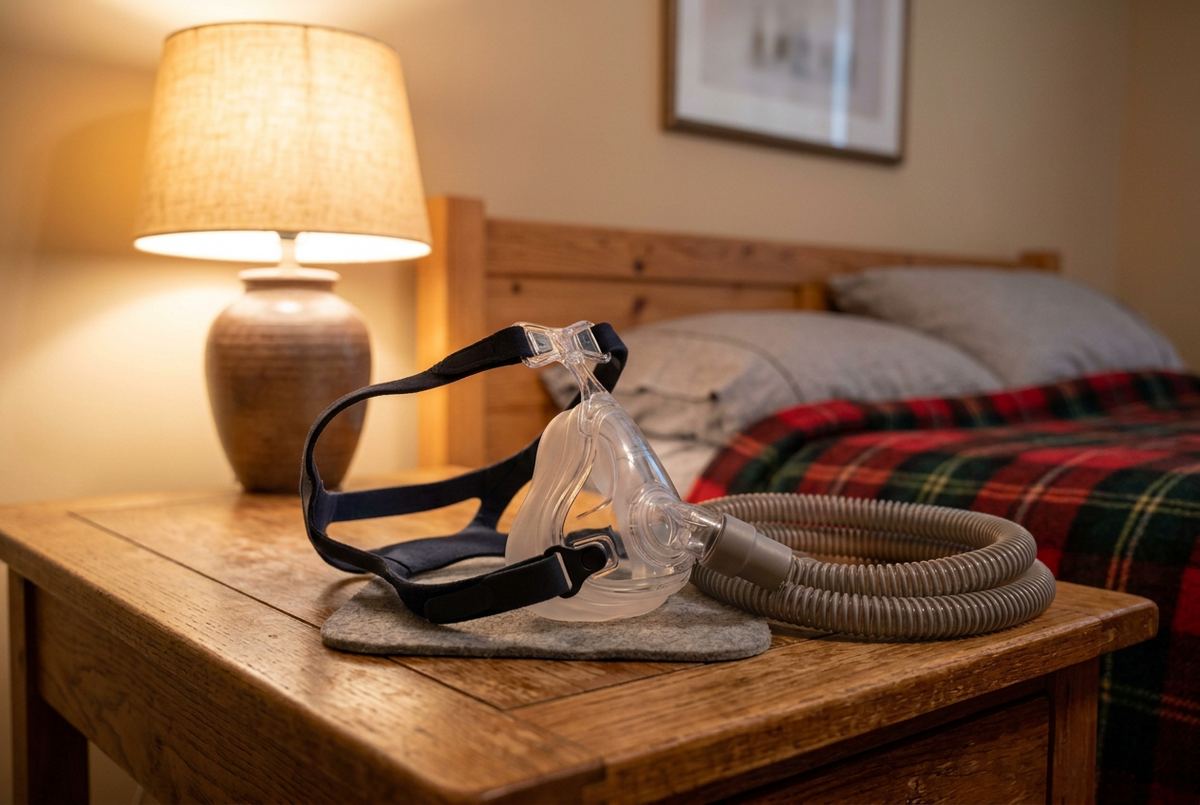
Several ResMed masks attach the headgear to the frame with small magnetic clips. You bring the strap close to the frame, the clip pulls into place, and you lift it away to undo it. If you are comparing masks, you will see the feature in product photos and descriptions. Before you settle on a magnetic mask, two questions need answers. Can your household use one safely? And if it can, does the particular mask suit the way you sleep?
Who should not use a ResMed mask with magnets
ResMed keeps its current guidance on a dedicated page about masks with magnetic clips. The company updated the contraindications and warnings on these masks in 2023, based on information gathered after the masks were in use. A contraindication is a situation where the mask should not be used at all. For ResMed masks with magnets, the contraindications apply when you, or anyone in close physical contact with you while you are wearing the mask, has:
- an active medical implant that interacts with magnets, such as a pacemaker, an implantable cardioverter defibrillator (ICD), a neurostimulator, a cerebrospinal fluid (CSF) shunt, or an insulin or infusion pump
- an implant or object containing ferromagnetic material, such as certain aneurysm clips, embolic coils, stents, valves, electrodes or ocular implants
The devices named above are examples taken from ResMed's labelling. They are not a complete list, and not every implant of a given type is affected in the same way. Whether a particular device falls into either group depends on what it is and what it is made of. Read the exact wording on ResMed's page, then check with the implant's manufacturer or the clinic that placed it if you are unsure. If you carry an implant identification card, it should name the device and its maker, which makes that conversation quicker.
The person beside you counts too
The phrase "anyone in close physical contact" is easy to read past. ResMed gives a bed partner as the example. If your partner has a pacemaker, the contraindication applies to your mask even though the implant is in someone else. The same reasoning covers anyone else who regularly sleeps close to you while the mask is on. When you are choosing a mask, ask the people in your household about implants instead of assuming you already know the answer.
If the contraindication applies to you
ResMed's advice is to replace a magnetic mask with one that has no magnets, in a timely manner, and to contact your mask provider for options. ResMed has made non-magnetic masks available to providers for this purpose. If you already own a magnetic mask and find out it is contraindicated for your household, contact your provider or the PAPSmart team to arrange an alternative. Speak with your sleep clinician before changing how you use your therapy while you wait.
The 6-inch warning is a separate rule
Alongside the contraindications, ResMed's labelling carries a general warning for everyone who uses one of these masks. It asks you to keep the mask magnets at least 6 inches (150 mm) away from implants or medical devices that may be adversely affected by magnetic interference. The warning covers you and anyone in close physical contact with the mask.
The two rules answer different questions. The warning is a distance precaution around devices that magnets may affect. The contraindication names situations where the mask should not be used at all. Keeping 6 inches of space does not make a contraindicated mask acceptable, so if your household falls under the contraindication, the answer is a mask without magnets.
ResMed also notes that the clips can come undone during sleep. If you wake up with loose headgear, find the clip and put it back on the strap instead of leaving it somewhere in the bed.
Finding out whether a mask has magnets
Product names do not always make it obvious. Two masks sold at PAPSmart that use magnetic headgear clips are the ResMed AirFit F20 full face mask and the ResMed AirFit N20 nasal mask. ResMed's guidance page lists the affected models and shows where the magnets sit on each one, so use it as your reference for any other ResMed mask or a newer version of one of these.
For a mask you already own, the model name is printed on the mask itself, usually on the frame or the cushion. Match that name against ResMed's list. If you are looking at a mask from another manufacturer, read that company's labelling. Philips, for example, has issued its own guidance for masks with magnetic parts, and its affected models and wording are different from ResMed's.
Shopping for a magnetic mask when your household is eligible
If nobody in your household falls under the contraindication, you can shop for a magnetic mask the same way you would any other: mask type, sizing and fit come first. A few extra details are worth checking because the clips are part of the headgear system.
Replacement clips and headgear
Clips are small, and a lost or broken one leaves the headgear without an anchor point. For some masks the clips are sold on their own. ResMed, for example, sells AirFit N20 clips as a two-pack in some markets. Before you commit to a mask, look up your model in the CPAP mask parts collection and see whether clips, headgear and cushions are listed. Knowing that the parts are stocked in Canada saves you from improvising later.
Clips and the quick-release elbow
The AirFit N20 listing at PAPSmart describes both magnetic clips and a quick-release elbow. They do different jobs. The clips let you take the headgear off the frame. The elbow lets you disconnect from the tubing and leave the mask on your face. If you get up during the night, the elbow means you can unhook from the machine without refitting the whole mask when you come back.
Mask type comes before clip style
A clip system does not change where or how a cushion seals. The clip style tells you nothing about whether a full face, nasal or pillow mask is right for you, so settle that question first with your clinician or fitter and treat the clips as a secondary feature. Sizing information for each mask comes from the manufacturer, and it is worth using even if you have worn a similar mask before, because sizing varies between models.
Shopping for a mask without magnets
If your household is contraindicated, or you would rather avoid magnets altogether, look for a mask whose headgear attaches with conventional clips, hooks or straps. The ResMed AirFit P10 nasal pillow mask is one ResMed model sold at PAPSmart that does not appear on ResMed's list of masks with magnets. Check the current list before you order, since product lines change and a new version of a mask may differ from the one you know.
Ruling out magnetic models shortens the list of masks to choose from, so it helps to start from the right list. If you are working from a contraindication, tell the PAPSmart team so that every option shown to you has been checked for magnets.
Before you order
- Ask everyone who sleeps close to you whether they have an implant or an active medical device.
- Compare any implants against the contraindications on ResMed's guidance page, and check with the implant manufacturer or clinic if the answer is unclear.
- Look up the mask you want on ResMed's list to confirm whether it has magnetic clips.
- If magnets are ruled out, choose from non-magnetic models only.
- Confirm that cushions, headgear and, for magnetic masks, spare clips are available for that model.
- Pick a size using the manufacturer's sizing information for that specific mask.
You can browse the full range of CPAP masks at PAPSmart, and the team can help narrow the list to non-magnetic models if your household needs one.


