

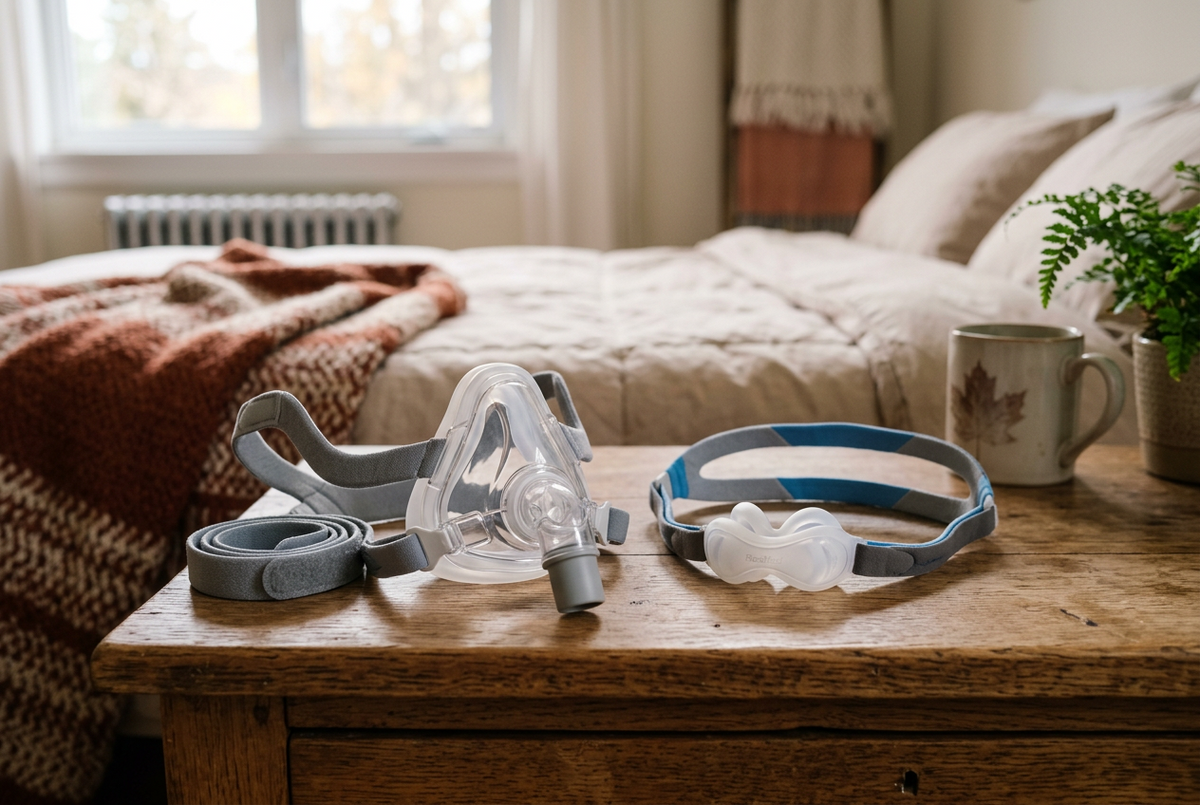
Nasal and nasal pillow masks both deliver air through the nose and leave the mouth uncovered. Past that, they sit on the face in different places. Some nasal masks cover the nose, some cradle it from below, and pillow masks seal at the openings of the nostrils. Comparing them comes down to where each one touches you and how that feels with air running and your head on a pillow.
Where each mask makes contact
Three ResMed masks show the range well, and each sits differently.
AirFit N20: a cushion over the nose
The ResMed AirFit N20 uses an InfinitySeal cushion that fits over the nose and seals around it. The PAPSmart listing describes a lightweight frame that sits below the eyes with integrated padding, along with magnetic headgear clips and a quick-release elbow. Because the cushion covers the nose, it touches the bridge and the sides of the nose as well as the area just above the upper lip.
AirFit N30 and N30i: a cradle under the nose
The AirFit N30 and N30i take a different approach. Their cushion sits beneath the nose, cradling it from below, so the bridge of the nose is left uncovered. On the N30i, the tube connects at the top of the head and the frame runs up the sides of the face to meet it. The contact area is lower on the face than with an over-the-nose design, though the cushion still sits close to the upper lip.
AirFit P10: pillows at the nostrils
The ResMed AirFit P10 is a nasal pillow mask. Two soft pillows sit at the entrance to the nostrils and form the seal there. The PAPSmart listing describes a three-part design, a woven-mesh QuietAir vent, split-strap headgear, and three pillow sizes in the box. The pillows and their small base sit under the nose, and the headgear straps run back over the head.
Comparing fit on your own face
Product photos only tell you so much. The useful comparison happens when you try a mask the way you will actually use it.
- Fit the mask with the machine running. The AirSense 11 user guide warns that fitting a mask without the device blowing air can lead to rebreathing exhaled air.
- Follow the fitting steps in the mask's own user guide, including its sizing instructions. If the box includes several pillow or cushion sizes, the guide explains how to choose between them.
- Lie down in the positions you normally sleep in. A mask that seals while you sit upright can behave differently once your cheek is on a pillow.
- On an AirSense 11, run the Mask Fit function from the MORE menu. ResMed describes it as a way to assess and identify possible leaks around the mask.
- After a night or two, look at the mask information in MY SLEEP VIEW or in the myAir app, which includes mask-fitting videos.
While you do this, pay attention to the specific points of contact. With an over-the-nose cushion, notice any pressure along the bridge. With an under-the-nose cradle, check the edge closest to the upper lip. With pillows, notice whether the nostrils feel comfortable and whether the seal holds when you move your head. These details are personal, and two people with similar faces can reach different conclusions about the same mask.
If you are struggling to find a size that works, a mask fitter or your sleep clinic can look at the fit with you in person. That can save you ordering one size after another at home.
Facial hair
A moustache or beard can sit under the edge of a cushion, and whether that affects the seal depends on the mask, where the cushion edge lands on your face, and how dense the hair is in that spot. There is no style that guarantees a moustache will stay clear of the seal. Under-the-nose cradles and pillow bases both sit near the upper lip, and over-the-nose cushions sit there too. The simplest check is to fit the mask in front of a mirror and see exactly where the cushion meets your skin, then run Mask Fit once you are lying down. A fitter who can see your face is the best help here.
Machine settings worth knowing about
Your sleep clinic sets your prescribed pressure, and that does not change when you switch mask styles. A few device features do interact with the mask type, though.
The AirSense 11 has a SmartStop feature that stops therapy a few seconds after you take the mask off, if your care provider has enabled it. The user guide notes that with a nasal pillows mask and a set pressure below 7 cm H2O, SmartStop may not work and should be disabled. If you are moving to a pillow mask and use SmartStop, it is worth raising with your provider.
If your prescribed pressure is on the higher side and you are considering a pillow mask for the first time, ask your clinician whether it suits your prescription before you buy. Comfort with direct airflow at the nostrils varies from person to person.
Humidity and nasal comfort
With either style, every breath from the machine passes through your nose, so nasal comfort is part of judging the fit. The AirSense 11 troubleshooting section links a dry or blocked nose with a humidity level that may be set too low, and suggests turning it up. It links water droplets on the nose, in the mask or in the tubing with humidity that may be too high or a tube temperature that may be too low. The humidity level can be set from Off up to 8 in MY OPTIONS. If you change masks and notice dryness or moisture that you did not have before, these settings are a reasonable place to start, and your provider can help if adjustments do not settle it.
When your mouth opens at night
Both styles rely on air going in through the nose. If your mouth opens during sleep, some air may escape that way. The AirSense 11 troubleshooting section links a very dry, uncomfortable mouth with air possibly escaping through the mouth, and mentions a chin strap or a full face mask as possible next steps. Which one fits your situation, if either, is something to work out with your clinician, who can also look at your therapy data.
Tube position and how you sleep
Where the tube leaves the mask changes how the hose behaves when you turn over. The N20 and P10 connect at the front, near the nose. The N30i connects at the top of the head. Whether either layout suits you depends on your sleep position and how much you move. When you test a mask lying down, notice where the tube lies, whether it tugs when you turn, and whether it catches on the pillow.
Compatibility and replacement parts
The AirSense 11 user guide asks you to use ResMed masks or other vented masks recommended by your prescribing doctor, and points to the Mask/Device compatibility list on ResMed's website for the full list. If your machine comes from another manufacturer, check its own guidance.
Cushions and pillows wear with use, and each mask's user guide gives its own replacement guidance. Parts for each model are listed in the CPAP mask parts collection. To compare complete systems, see the nasal masks and nasal pillow masks at PAPSmart.


