

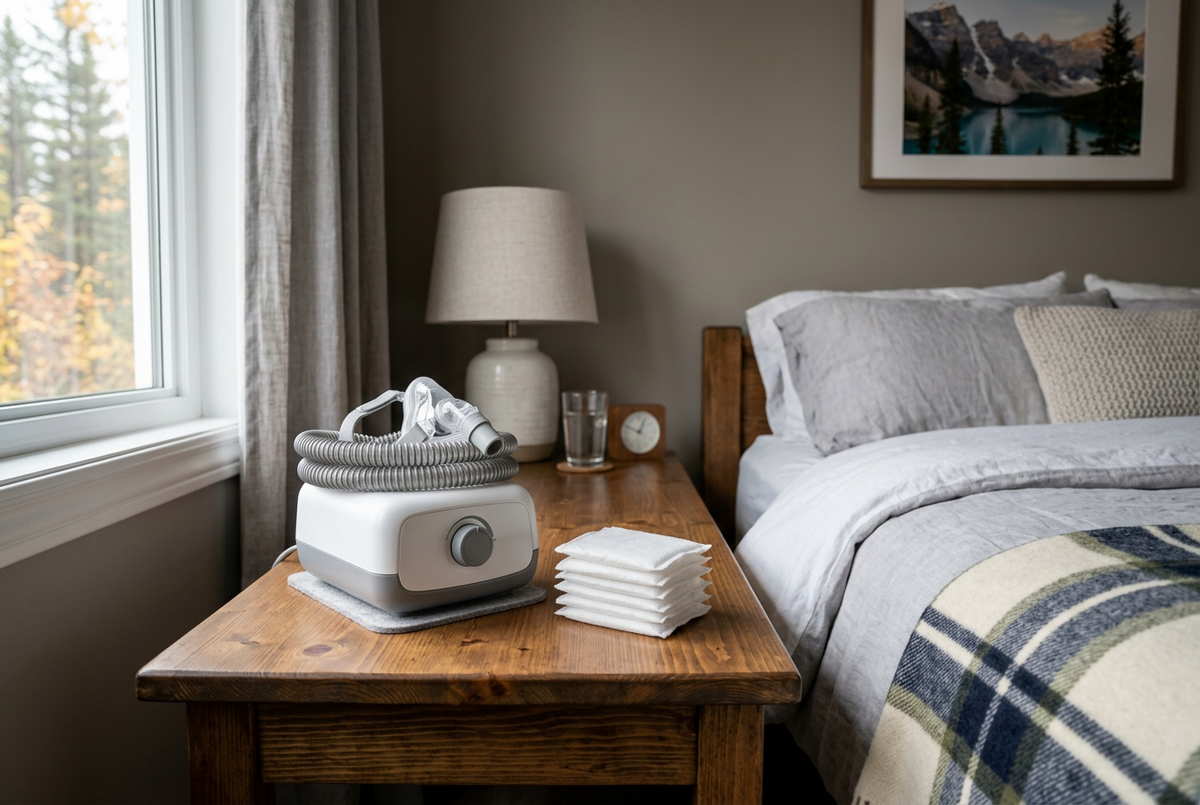
CPAP filters are one of the easiest parts of therapy to overlook and one of the most important to stay on top of. Every breath your machine delivers passes through the filter before reaching your airway. A clean, functioning filter traps dust, allergens, and fine particles. A clogged or damaged filter can restrict airflow. Checking and replacing your filter on schedule is one of the simplest things you can do to protect both your therapy and your machine.
Why CPAP Filters Matter
Your CPAP machine runs for several hours every night, pulling air from your bedroom through a filter and delivering it directly to your airway. Over time, that filter accumulates dust, pet dander, pollen, and fine airborne particles. A blocked filter can restrict airflow.
For people with allergies or asthma, a dirty or damaged filter represents a more direct health concern. Replacing or inspecting your filter regularly is not just a maintenance task — it is part of ensuring your therapy delivers clean air every night.
Types of CPAP Filters: Disposable vs Reusable
Not all CPAP machines use the same filter system. Some machines use a single disposable filter only. Others use a two-stage system with a reusable coarse filter and a disposable fine filter. Always follow the user guide for your specific machine model — do not assume your machine uses the same filter type as another.
Disposable Filters
Disposable filters are designed for single use. Once they are dirty, blocked, or damaged, they must be discarded and replaced with a new filter. Disposable filters must not be washed or reused. Washing a disposable filter damages the filter material and significantly reduces its ability to trap fine particles. A washed disposable filter may look clean but no longer provides effective filtration.
Reusable Filters
Some machines include a reusable foam or coarse filter as a first stage, designed to catch larger airborne debris. Where a reusable filter is specified in your device's user guide, it can typically be rinsed under warm water and allowed to dry completely before reinserting. Always allow a reusable filter to dry fully before putting it back in the machine. Even reusable filters have a finite lifespan and must eventually be replaced — consult your device's user guide for the specific interval.
Filter Types and Official Replacement Guidance by Machine
The table below summarises the filter type and official replacement guidance for common machines available in Canada. Always refer to your device's own user guide for the authoritative interval, as recommendations can vary by model variant and environment.
| Machine | Filter Type | Washable? | Official Replacement Guidance |
| ResMed AirSense 10 | Disposable (standard or hypoallergenic) | No — not washable or reusable | Replace at least every six months; replace sooner if holes, blockages, dirt or dust are present (per ResMed AirSense 10 user guide) |
| ResMed AirSense 11 | Disposable (standard or hypoallergenic) | No — not washable or reusable | Replace at least every six months; replace sooner if holes, blockages, dirt or dust are present (per ResMed AirSense 11 user guide) |
| ResMed AirMini | Disposable (AirMini-specific) | No — not washable or reusable | Replace per AirMini user guide; replace sooner if blocked or damaged |
| Philips DreamStation 2 | Disposable ultra-fine filter; reusable pollen filter (where applicable) | Disposable: No. Reusable pollen filter: refer to DreamStation 2 user guide | Refer to your DreamStation 2 user guide for model-specific intervals |
Always use filters specified for your machine model. Filters from different brands or models may not seat correctly, leaving gaps that allow unfiltered air to enter the device.
How to Know When to Replace Your Filter Early
The minimum replacement schedule in your user guide is a floor, not a ceiling. Several factors shorten filter life and may mean you need to replace before the stated interval.
Pet hair and dander can block filters faster than normal household dust. If you have a dog or cat that sleeps in the bedroom, inspect your filter more frequently than the standard schedule. Similarly, if you live near a construction site, have recently done home renovations, or experience seasonal allergy periods with high pollen counts, check the filter more often and replace it as soon as it shows visible discolouration, holes, or resistance when held up to light.
Your device user guide is the authoritative source for your specific machine. If you are unsure, consult it directly or contact PAPSmart for guidance.
Where to Buy CPAP Filters in Canada
Buying filters from an authorized Canadian retailer ensures you are getting the correct filter for your specific machine model. Generic or mismatched filters may not seat properly or may not provide adequate filtration. PAPSmart carries filters for ResMed, Philips Respironics, and Fisher and Paykel machines.
Browse CPAP filters in Canada at PAPSmart by brand and machine model to find the right filters for your setup.
Frequently Asked Questions
How often should I replace my CPAP filter?
Follow the replacement schedule in your device's user guide — it is the authoritative source for your specific machine. For ResMed AirSense 10 and AirSense 11, the official user guides specify replacing the filter at least every six months, or sooner if it shows holes, blockages, dirt, or dust. Replace earlier if your environment is dusty, if you have pets in the bedroom, or if the filter appears visibly dirty or damaged.
Can I wash my CPAP filter?
That depends entirely on your machine model and filter type. ResMed AirSense 10, AirSense 11, and AirMini filters are explicitly described as not washable or reusable in their official user guides — they must be discarded and replaced. Some machines include a separate reusable filter stage; refer to your own device's user guide to confirm what applies to your machine.
What happens if I do not replace my CPAP filter?
A blocked or damaged filter restricts airflow to the machine. Your device's user guide should be your primary reference for what to do if a filter issue is suspected. Always replace a filter that shows holes, visible blockage, or dirt accumulation, regardless of how long it has been in use.
Do I need to replace both filters at the same time?
Only if your machine uses two filter types. The AirSense 10 and AirSense 11 each use a single disposable filter. If your machine has both a reusable and a disposable filter stage, each follows its own replacement schedule as specified in your user guide — they will not necessarily need changing at the same time.
Are CPAP filters covered by insurance in Canada?
Some extended health benefit plans include coverage for CPAP replacement supplies. Check your specific plan for coverage details, eligible items, and any documentation requirements before purchasing.


