

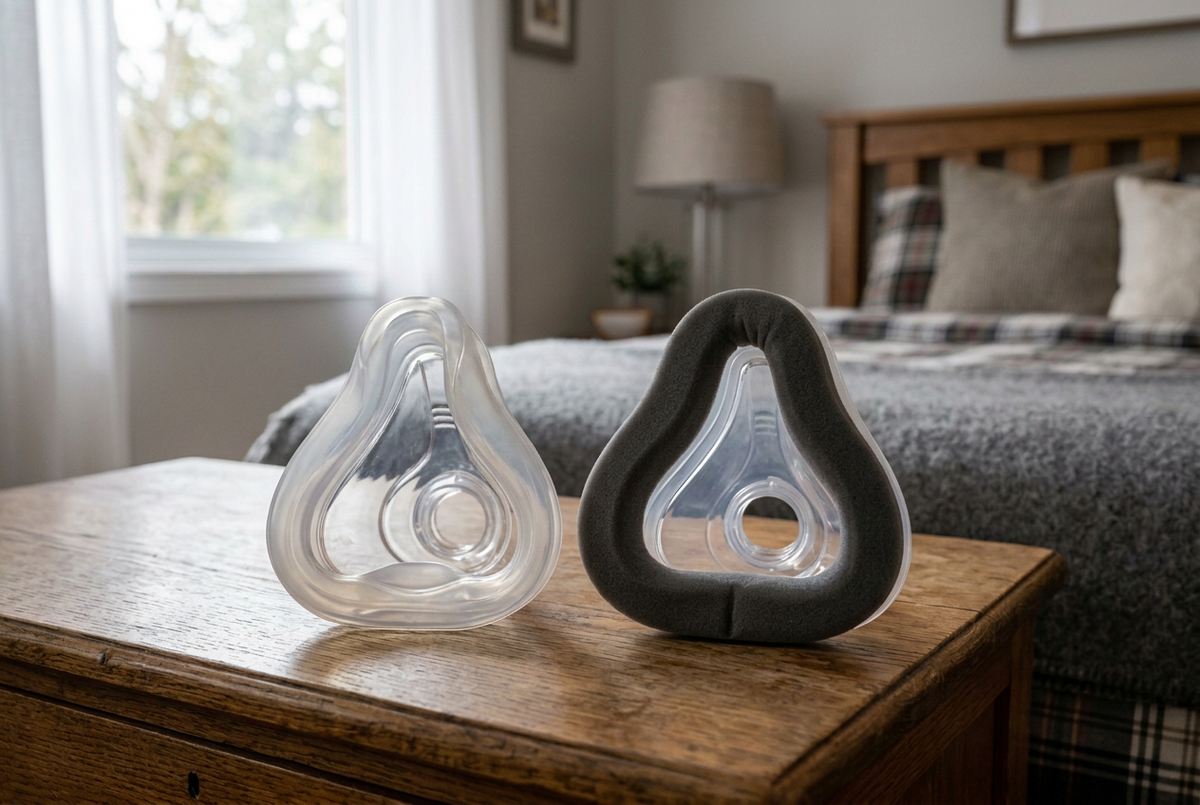
When you reorder a cushion, the material is easy to overlook, especially if the product names look almost identical. For two ResMed mask families, the same frame can take either a silicone cushion or a memory foam one. The two are cleaned differently and replaced on different schedules, so it helps to know which one you have before you buy the next.
Where you get a choice of material
The F20 family
The ResMed AirFit F20 is a full face mask with a silicone InfinitySeal cushion. The AirTouch F20 uses the same style of frame with a cushion made of ResMed's UltraSoft memory foam. ResMed states that the AirTouch F20 cushion is compatible only with AirFit F20 or AirTouch F20 masks, and that parts are interchangeable between the two, so you can move between silicone and foam without replacing the frame. The PAPSmart listing adds that the foam cushion fits the AirTouch F20 For Her as well.
The N20 family
The AirFit N20 nasal mask uses a silicone InfinitySeal cushion. The AirTouch N20 nasal cushion is the memory foam option, and the PAPSmart listing describes it as compatible with both the AirTouch N20 and the AirFit N20. The listing describes the foam as adapting to individual facial contours. As with the F20 family, that means a nasal mask user can try foam on an existing N20 frame.
Outside these two families
For any other mask, assume the cushion is specific to that model until the manufacturer says otherwise. The AirTouch name does not always mean memory foam either. The AirTouch N30i, for example, uses a fabric-wrapped cushion with its own care instructions. Always check the listing and the user guide for the exact product before buying or cleaning it. If you are unsure, the PAPSmart team can check a cushion against your mask model before you order.
How the two materials compare in use
Silicone cushions such as the InfinitySeal are designed to be washed, and the mask's user guide gives the method and how often to do it. The AirSense 11 user guide sends readers to the mask guide for cleaning instructions, which is a reminder that each mask has its own.
ResMed describes its UltraSoft memory foam as adapting to your facial profile while remaining breathable. Comfort is individual. Some people prefer the feel of foam against the skin, and others prefer silicone. Neither material guarantees a better seal for any one person. Fit, size and headgear adjustment affect the seal with either one.
Whatever the material, the AirSense 11 user guide gives a general rule for system components: if you see visible deterioration such as cracking, discolouration or tears, discard the part and replace it.
Caring for the AirTouch F20 foam cushion
ResMed is specific about this cushion, and the instructions differ from those for a washable silicone cushion. According to ResMed:
- the memory foam cushion should not be washed or immersed in water
- it can be wiped over if it needs cleaning, and it does not need cleaning every day
- it should not be stored in direct sunlight
- it should be discarded and replaced if any visible deterioration appears
The PAPSmart listing for the cushion says the same thing in its own words: clean it only with non-alcoholic wipes and do not submerge it in any cleaning solution or water. On replacement, ResMed recommends changing the AirTouch F20 cushion every month, or sooner if it shows deterioration. ResMed also states that the AirTouch F20 is for patients weighing more than 30 kg.
If you travel, or if someone else in your home helps with cleaning, this detail is easy to forget. Keep suitable wipes with the mask and make sure anyone who handles it knows the foam cushion stays out of the sink.
Caring for the AirTouch N20 foam cushion
The AirTouch N20 cushion is also memory foam, but follow the user guide that comes with it rather than borrowing the F20 schedule. The replacement interval and cleaning steps for one ResMed foam cushion are not automatically the same as for another. If the guide is missing, ResMed's support site and the PAPSmart team can point you to the current version.
Caring for silicone cushions
Each silicone cushion follows its own mask guide for washing method and replacement timing. Use the cleaning products that guide recommends instead of whatever happens to be under the sink. For comparison, ResMed's AirSense 11 guide rules out bleach, chlorine, aromatic-based solutions, moisturising or antibacterial soaps and scented oils for the device, tub and tubing, which shows how specific these instructions can be.
Trying the other material
Because the F20 and N20 frames accept both cushion types, you can test the other material without buying a whole new mask. Order a single cushion in the size you already use, read its care instructions before the first night, and fit it the same way you fit your current cushion. On an AirSense 11, run the Mask Fit function from the MORE menu after fitting, and check the mask seal information in MY SLEEP VIEW over the next few nights. Comparing a week on each cushion gives you something more concrete than a single night's impression.
Keep your previous cushion clean and stored according to its own guide while you test, so you can switch back if you prefer it. If neither cushion seals well, the issue may be size or fit rather than material, and a fitter can help you sort out which.
Deciding which to buy
If you already use one of these masks and the cushion suits you, there is no reason to change. If you are curious about the other material, the shared frame makes it a low-commitment experiment. A few points to weigh:
- Cleaning routine. Silicone is washed according to its guide. The F20 foam cushion is wiped only, so you will need suitable wipes on hand at home and when you travel.
- Replacement frequency. ResMed recommends monthly replacement for the AirTouch F20 cushion. Compare that against the interval in the guide for the silicone cushion you would otherwise use, and against current prices, to see what each option costs you over a year.
- Availability. You will be reordering whichever cushion you choose, so check that it is stocked in your size before you commit to it.
- Skin comfort. If marks or irritation where the cushion sits are bothering you, mention them to your clinician or fitter. They may suggest a size or adjustment change, a different material, or a different style of mask.
Ordering the right cushion
- Find the model name on your mask, usually printed on the frame or the cushion. If the printing has worn off, the original packaging or your order history will show it.
- Decide whether you want silicone or memory foam, and confirm the cushion you choose is listed as compatible with that frame.
- Choose the size. ResMed sells AirTouch F20 cushions in small, medium and large; check the sizing information for your mask, and the For Her range if you use it.
- Read the care instructions for that exact cushion before its first use.
Replacement cushions for each model are grouped in the CPAP cushions collection, with headgear and other parts in the wider mask parts collection.


