

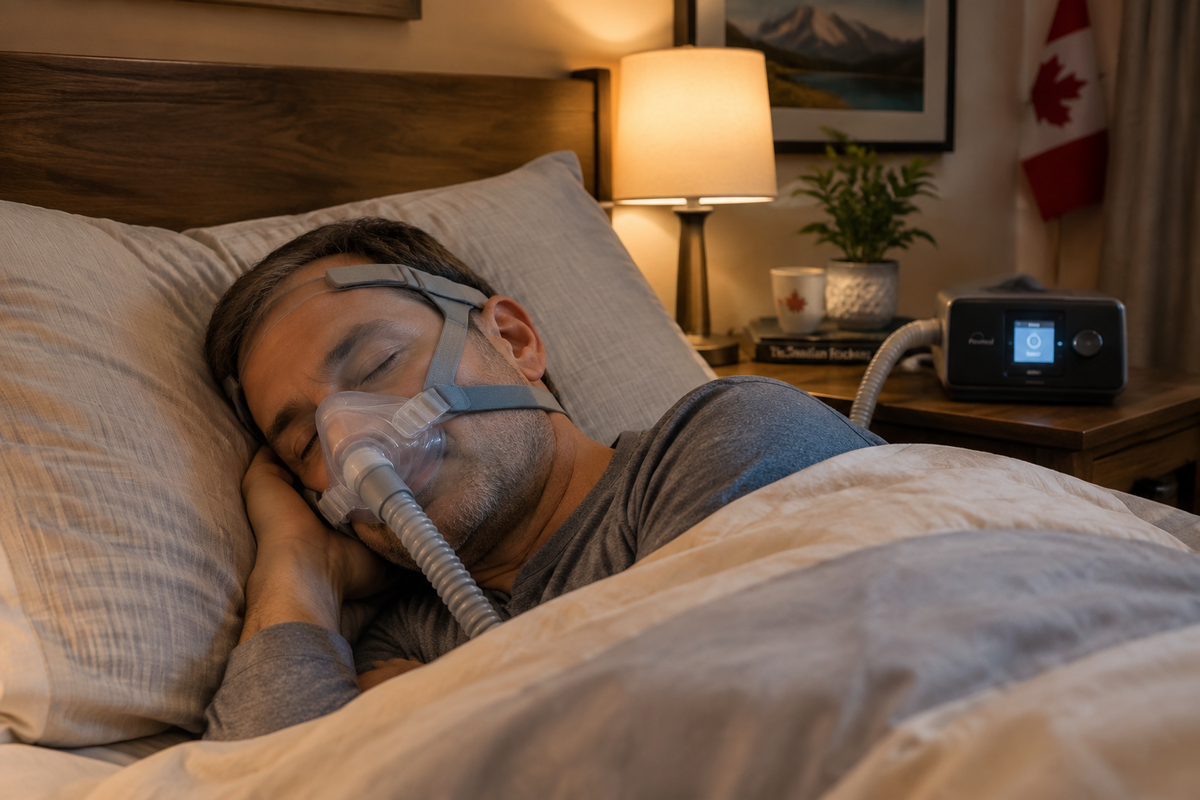
BiPAP therapy is prescribed less often than CPAP, but for the patients who need it, it makes a substantial difference in both comfort and clinical effectiveness. If your sleep specialist has mentioned BiPAP, or if you have tried CPAP and found exhaling uncomfortable at your prescribed pressure, this guide covers everything you need to know about BiPAP machines in Canada: how they work, who they are prescribed for, and how to choose the right model.
What Is a BiPAP Machine?
BiPAP stands for Bilevel Positive Airway Pressure. Unlike a CPAP machine, which delivers a single continuous pressure throughout the night, a BiPAP machine delivers two distinct pressures: a higher pressure when you inhale (IPAP) and a lower pressure when you exhale (EPAP). The pressure drops the moment you begin to exhale, which makes breathing feel considerably more natural, particularly at higher therapy pressures.
This bilevel approach solves the main complaint of CPAP users at high pressure settings: the sensation of having to breathe out against a strong, constant airflow. At moderate pressures, most people adapt to CPAP without difficulty. At pressures above 15 cm H2O, however, exhaling against continuous airflow becomes uncomfortable enough to disrupt sleep or reduce therapy compliance. BiPAP eliminates this problem by stepping the pressure down on every exhale.
Who Is Prescribed a BiPAP Machine?
BiPAP is not a substitute for CPAP in most cases. It is prescribed for specific clinical situations where CPAP either does not provide adequate therapy or is not tolerable at the pressures required. The most common reasons a sleep specialist prescribes BiPAP include:
- Obstructive sleep apnea (OSA) requiring a therapy pressure above 15 cm H2O
- Difficulty exhaling comfortably against continuous CPAP pressure despite pressure relief settings
- Central sleep apnea, where the brain fails to send consistent breathing signals
- Complex sleep apnea syndrome, a combination of obstructive and central patterns
- Chronic obstructive pulmonary disease (COPD) requiring ventilatory support
- Obesity hypoventilation syndrome
- Neuromuscular conditions affecting breathing
If you have been diagnosed with standard obstructive sleep apnea at a moderate pressure setting and are tolerating therapy comfortably, BiPAP is unlikely to be prescribed. It is a clinical tool for specific situations, not an upgrade for its own sake.
BiPAP vs CPAP: Key Differences
| Feature | CPAP | BiPAP |
| Pressure delivery | Single continuous pressure | Two pressures: higher inhale (IPAP), lower exhale (EPAP) |
| Best suited for | Most cases of obstructive sleep apnea | High pressure OSA, central sleep apnea, COPD, complex cases |
| Comfort at high pressure | Can feel difficult to exhale | Easier to exhale, pressure drops on each breath out |
| Price range (Canada) | $700 to $1,200 CAD | $1,200 to $3,000+ CAD |
| Prescription required | Yes | Yes |
| Auto-adjusting version | Yes (APAP) | Yes (Auto BiPAP or ASV) |
Types of BiPAP Machines Available in Canada
BiPAP machines come in fixed and auto-adjusting configurations, similar to CPAP. A fixed BiPAP delivers the same IPAP and EPAP settings every night as specified in your prescription. An Auto BiPAP adjusts both pressure levels in real time based on your breathing patterns, providing exactly the support your airway needs at each moment.
A third category, Adaptive Servo-Ventilation (ASV), is a more advanced form of bilevel therapy designed specifically for complex and central sleep apnea. ASV machines monitor your breathing pattern continuously and adjust both the pressure support and backup breathing rate in real time. ASV is reserved for specific clinical situations and is prescribed when standard BiPAP does not adequately treat the pattern of breathing disruptions detected during your sleep study.
Your sleep specialist's prescription will specify which type is appropriate and will include your IPAP and EPAP settings. Do not adjust these settings without guidance from your care team, as incorrect pressure settings affect both the safety and effectiveness of therapy.
BiPAP Machines Available at PAPSmart
PAPSmart carries a range of BiPAP machines from ResMed and Philips Respironics, the two dominant manufacturers in the Canadian market. Both brands produce clinically reliable bilevel devices that support the full range of prescribed pressure settings.
ResMed's AirCurve series is the most widely prescribed BiPAP range in Canada. The AirCurve 10 VAuto is the most common model, offering auto-adjusting bilevel pressure with the same myAir app connectivity found on the AirSense machines. For patients with more complex requirements, the AirCurve series also includes ASV options. Philips Respironics' DreamStation BiPAP models provide an alternative for clinics and patients already in the Philips ecosystem.
Browse the full range of BiPAP machines available in Canada at PAPSmart
Do BiPAP Machines Use the Same Masks?
Yes. The same CPAP mask styles, full-face, nasal, and nasal pillow, work with BiPAP machines. Both use a standard 22mm connection, so mask selection is based on your breathing habits, sleeping position, and comfort preferences rather than which machine type you are using. Browse the full range of CPAP masks at PAPSmart for use with both CPAP and BiPAP machines.
Does Insurance Cover BiPAP Machines in Canada?
Coverage for BiPAP machines varies by province and by insurance plan. Most extended health benefit plans that cover CPAP equipment also cover BiPAP, though the approved amounts and replacement schedules may differ. Provincial programs such as Ontario's Assistive Devices Program (ADP) and Alberta's AADL program also cover BiPAP equipment for eligible residents.
A valid prescription and documented diagnosis are required for any insurance claim. PAPSmart provides itemized receipts and the documentation most Canadian insurers require to process a BiPAP equipment claim.
Frequently Asked Questions
Is BiPAP better than CPAP?
Not universally. For patients with standard obstructive sleep apnea at moderate pressure settings, CPAP is just as effective and more affordable. BiPAP is better for patients who need high therapy pressures, have central sleep apnea, or struggle to exhale comfortably against continuous CPAP pressure. Your sleep specialist's prescription determines which is appropriate for your diagnosis.
Can I switch from CPAP to BiPAP on my own?
No. Switching devices requires a new prescription with updated IPAP and EPAP settings from your sleep specialist. Using a BiPAP with incorrect settings can undertreat your sleep apnea or cause pressure-related discomfort. If you feel your CPAP is not working well, contact your sleep clinic before making any changes.
How much does a BiPAP machine cost in Canada?
BiPAP machines in Canada typically range from $1,200 to $3,000 or more, depending on the model and whether it is a fixed or auto-adjusting device. ASV machines sit at the higher end of this range. Buying from an authorized online retailer like PAPSmart is typically significantly more affordable than purchasing through a sleep clinic.
Do I need a prescription for a BiPAP machine in Canada?
Yes. BiPAP machines are classified as medical devices in Canada and require a valid prescription from a licensed physician. Your prescription will specify the machine type and your IPAP and EPAP pressure settings.
What is the difference between BiPAP and ASV?
BiPAP delivers two fixed or auto-adjusting pressure levels to make breathing easier. ASV is a more advanced bilevel device that continuously adapts both pressure support and the breathing rate backup in response to your real-time breathing pattern. ASV is prescribed specifically for complex and central sleep apnea when standard BiPAP is insufficient.


